
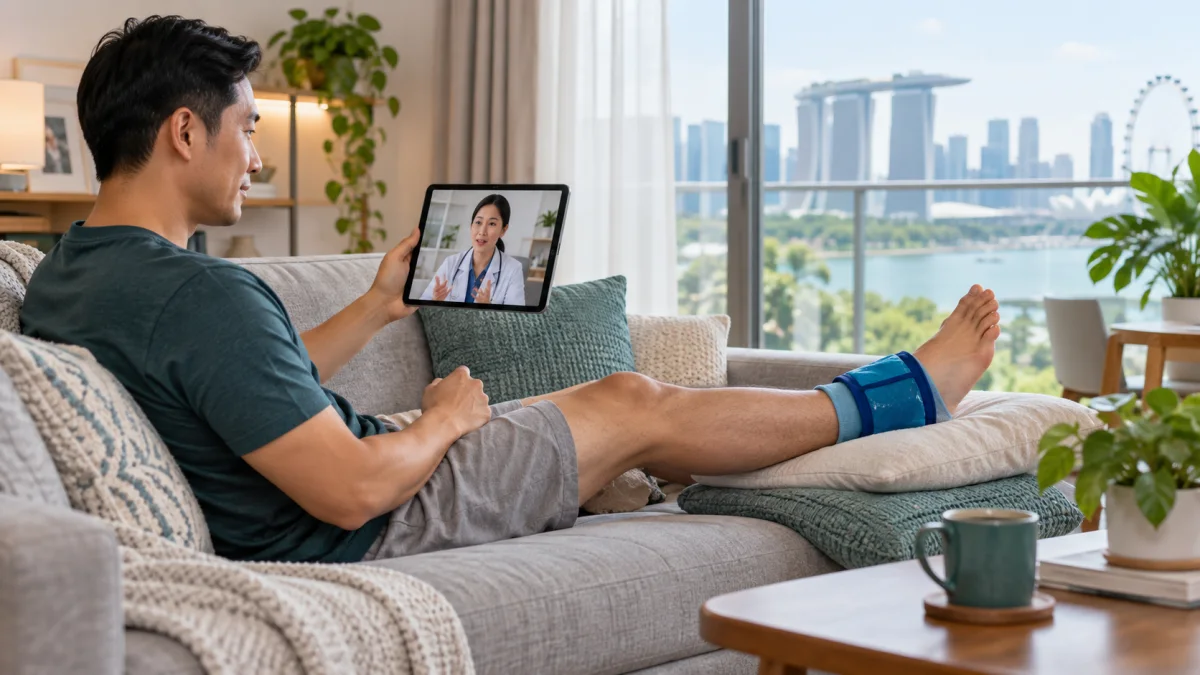
Telemedicine in Singapore can support early triage of a mild ankle sprain, especially when the person can describe the injury and show both ankles clearly on video. A doctor can guide initial care and decide whether a clinic, X-ray or other assessment is needed.
An ankle that looks “sprained” can still have a fracture, tendon injury or severe ligament tear. Video cannot press specific bones, test stability or provide imaging, so the goal is a safe next step rather than a guaranteed diagnosis from home.
What happens in an ankle sprain
SingHealth describes an ankle sprain as stretching or tearing of ligaments that stabilise the joint, commonly after the foot twists inward. Pain, swelling, bruising and restricted movement can follow. More severe injuries may involve bone, cartilage or tendons.
Video triage may be reasonable when:
- The injury followed a simple twist rather than a fall from height or major collision
- There is no obvious deformity or open wound
- Pain and swelling are mild
- The foot is warm and its usual colour
- There is no numbness or persistent tingling
- The person can take several careful steps
- Symptoms are stable or starting to improve
Do not repeatedly walk on the ankle just to prove that you can. Tell the doctor what happened during necessary movement after the injury.
Prepare for the video assessment
Wear shorts or loose clothing so the doctor can see from the lower leg to the toes. Sit somewhere safe with good light and have another adult hold the camera if possible.
Prepare:
- The exact twisting, landing or impact mechanism
- Whether you heard or felt a crack, snap or pop
- Whether you could walk immediately and can bear weight now
- Where pain is strongest, including directly over ankle or foot bones
- How quickly swelling and bruising appeared
- Numbness, tingling, coldness or colour change
- Previous ankle injuries, surgery or instability
- Relevant medicine, pregnancy, stomach, kidney or bleeding history
Take front, side and back photographs of both ankles from the same distance. A comparison can make swelling or bruising clearer. Do not force a painful range of motion or perform hopping tests without instruction.
Early care while waiting
SingHealth uses the PRICE approach: protection, rest, ice, compression and elevation. Protect the ankle from further twisting and rest from activity that worsens pain. Apply a cold pack wrapped in cloth for short intervals rather than placing ice directly on skin. Elevate the ankle above heart level when practical.
Compression may reduce swelling when applied correctly, but it should feel supportive rather than tight. Loosen or remove it if the toes become numb, cold, pale, blue or increasingly painful. A clinician can advise whether a brace or walking aid is appropriate.
Pain medicine is not one-size-fits-all. Anti-inflammatory medicines may be unsuitable for some people with pregnancy, kidney disease, stomach ulcers, bleeding risks or other medicines. Check with the doctor or pharmacist.
What telemedicine cannot rule out
A doctor deciding about an X-ray may need to examine precise areas of bone and assess weight-bearing. Video self-palpation is less reliable and should not be used to declare an ankle fracture-free.
Physical assessment is important for:
- Inability to take four steps because of pain
- Pain directly over the bony tips or back edge of either ankle
- Midfoot pain, especially over prominent foot bones
- Major swelling, rapidly developing bruising or severe tenderness
- Persistent instability, locking or inability to move the ankle
- Symptoms that are not improving after about three days
These features do not prove a fracture, but they increase the need for examination and possible imaging.
When urgent in-person care is safer
Seek urgent assessment for a crooked ankle, an open wound, bone visible through skin, severe or escalating pain, numbness, weakness, or a foot that is cold, pale or blue. Major trauma, a fall from height or injury with head, neck or back symptoms also needs physical care.
SingHealth advises seeing a doctor when severe pain and swelling, inability to move or bear weight, numbness or coldness, an unusual shape or lack of improvement is present. Do not eat or drink if emergency clinicians advise that a procedure may be needed.
Recovery needs a graded plan
If a clinician confirms that home management is suitable, follow the advised progression. Prolonged complete rest can leave the joint stiff, but returning to running or sport before strength and balance recover increases reinjury risk. Rehabilitation or physiotherapy may be recommended.
Arrange follow-up if swelling or pain persists, the ankle repeatedly gives way or normal walking does not return. A minor-looking injury that fails to improve deserves reassessment.
For pain centred in the lower back rather than the ankle, use the back-pain telemedicine guide. For help choosing the right care setting, read teleconsult or clinic in Singapore.
Sources reviewed
- SingHealth: Acute ankle sprain
- SingHealth: Strains and sprains
- SingHealth: Medical emergencies
- HealthHub: Using telemedicine the safe way
- MOH: Healthcare services regulation and licensing
Frequently asked questions
Can telemedicine assess an ankle sprain in Singapore?
Video may help triage a mild ankle injury, guide early care and decide whether examination or imaging is needed. It cannot reliably exclude every fracture or severe ligament injury.
What should I do immediately after an ankle sprain?
Protect the ankle, rest from painful activity, use a wrapped cold pack for short intervals, apply comfortable compression if appropriate and elevate it. Stop if compression causes numbness, coldness or colour change.
When does an ankle injury need urgent examination?
Seek prompt physical care for deformity, severe pain or swelling, numbness, a cold or pale foot, an open wound, inability to bear weight or pain directly over the ankle bones.
For a mild ankle sprain without warning signs, join the OnlineDoctor.sg teleconsult queue.